
On this page
Streaming protocols explained: RTMP, SRT, RTSP, WebRTC, WHIP, WHEP, HLS and LL-HLS
Live video uses different protocols on the way in and on the way out. Ingest protocols are built to get one stream reliably from an encoder or camera to a server. Delivery protocols are built to get it to many viewers on whatever device they hold. A streaming server's main job is translating between the two.
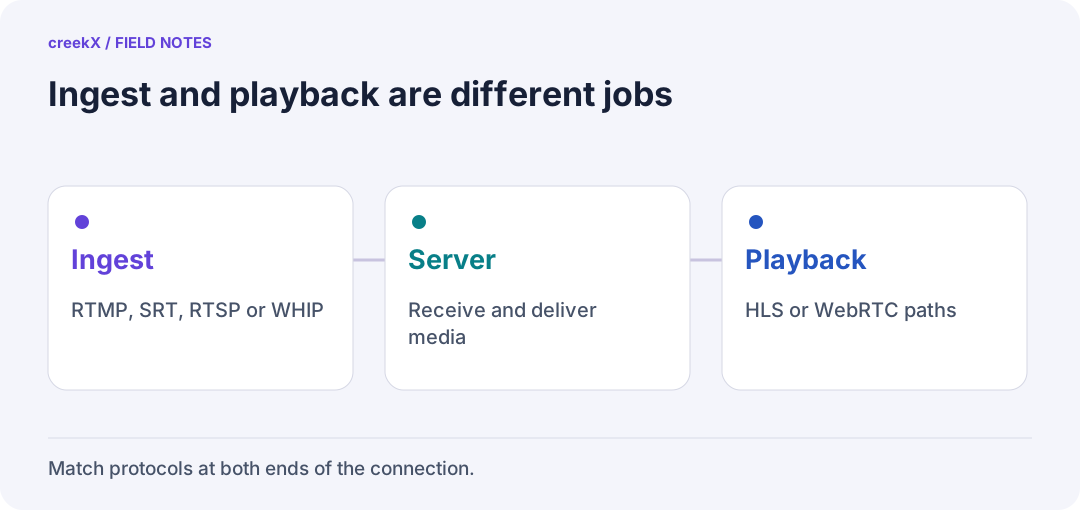
- IngestRTMP, SRT, RTSP or WHIP
- ServerReceive and deliver media
- PlaybackHLS or WebRTC paths
All of them at a glance
| Protocol | Used for | Transport | Typical latency | Plays in a browser |
|---|---|---|---|---|
| RTMP | Ingest; push to platforms | TCP | 1–3 s | No |
| RTMPS | Encrypted RTMP | TCP + TLS | 1–3 s | No |
| SRT | Ingest over the internet; server to server | UDP with retransmission | Network + window (often 0.2–2 s) | No |
| RTSP | IP cameras | TCP control, RTP over UDP or TCP | Under 1 s | No |
| MPEG-TS over UDP | Broadcast gear on a LAN | UDP | Under 1 s | No |
| WebRTC + WHIP | Ingest from a browser or OBS | UDP (TCP fallback) | Under 1 s | Sends from it |
| WebRTC + WHEP | Real-time delivery | UDP (TCP fallback) | Under 1 s | Yes |
| LL-HLS | Low-latency delivery at scale | HTTPS | 1–5 s | Yes (Safari natively, others via a JS player) |
| HLS | Delivery to everything, CDNs | HTTPS | 6–30 s | Yes (Safari natively, others via a JS player) |
Ingest protocols
RTMP
The universal sender: every encoder, every platform. TCP, so it stalls on packet loss over long distances. Default port 1935. Use RTMPS on the internet, because plain RTMP sends the stream key in clear text.
SRT
UDP with selective retransmission inside a latency window you choose (start near four times the round-trip time), plus AES encryption with a passphrase. The best choice for contribution over the public internet and cellular links: SRT over bad networks.
RTSP
The IP camera protocol. Usually the server connects to the camera and pulls. Low delay, but browsers cannot play it, so it is always converted: RTSP to WebRTC.
WHIP
A standard way to publish WebRTC with one HTTP request. It lets a browser go live with nothing installed, and OBS supports it as an output.
Delivery protocols
WebRTC with WHEP
The only sub-second option in an ordinary browser. Each viewer is a live session, so the server works per viewer and a normal CDN cannot cache it. creekX measured 0.49 s median on a local network and 500 viewers of one 1080p live at 37% of a 4-core server (benchmarks). Details: WHIP and WHEP explained.
HLS
Segments and playlists over plain HTTPS. Plays everywhere, caches on any CDN, adapts quality with an ABR ladder. Slow by default because players buffer several segments.
Low-latency HLS
HLS with partial segments and blocking playlist requests, bringing delay to one to a few seconds while staying cacheable. creekX measured 1.23–1.28 s median: low-latency HLS.
A note on DASH
MPEG-DASH is the codec-neutral cousin of HLS, common with DRM and smart TVs. Apple devices do not play it natively, so HLS is the safer single choice for the web.
Which to choose
- From OBS on a good network: RTMP (RTMPS over the internet).
- From the field, cellular, other continents: SRT.
- From cameras: RTSP, pulled by the server.
- From a browser: WHIP.
- To people who act on what they see: WebRTC (WHEP).
- To large audiences with chat: LL-HLS.
- To everyone else, and CDNs: HLS.
Every one of these, in the context of a whole system: the streaming server guide. Which ports each one needs open: ports and firewall rules.
Try it. creekX Media Server installs on Ubuntu 24.04 with one command and is free for 14 days: install it, or start with the quick start.
Implementation check
Write a two-sided protocol requirement
You need: Your encoder specification and the browsers or receiving platforms you must serve.
- Choose a source-to-server protocol the encoder actually supports.
- Choose server-to-viewer delivery separately; include codecs and access rules, not just protocol names.
- Publish one feed and test both ends before expanding the architecture.
Pass when: The requirement describes ingest and delivery as separate interfaces with a tested media format.
If it fails: SRT or RTSP support on an encoder does not mean a browser can open its address directly.
Frequently asked questions
Which streaming protocol has the lowest latency?
WebRTC, under a second; creekX measured 0.49 s median on a local network. LL-HLS is 1-5 s and HLS 6-30 s.
Is RTMP still used?
Yes, as the universal way for encoders to send to servers and platforms. No browser plays it, so it is not used for delivery.