
On this page
Self-hosted vs cloud streaming server: 12-month cost at 10, 50, 200 streams
A managed cloud service bills every hour a stream is live and every hour someone watches it. A self-hosted streaming server bills you for a machine, its bandwidth and a licence, whatever the meter would have said. Below is the arithmetic for one realistic workload at three sizes, with each assumption written down so you can replace it with your own.
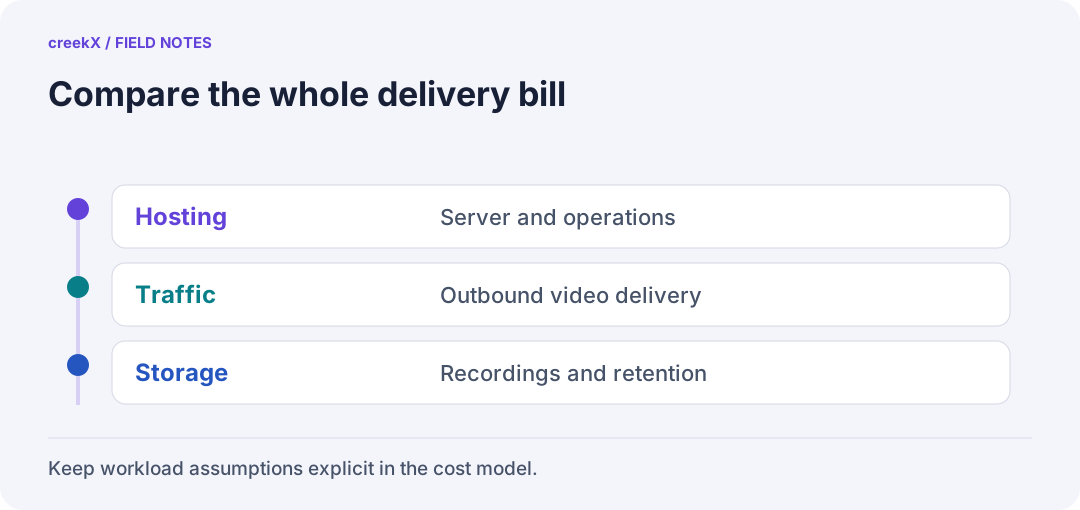
- HostingServer and operations
- TrafficOutbound video delivery
- StorageRecordings and retention
The workload
- Streams: 10, 50 or 200 live 1080p inputs.
- Hours: each stream live 200 hours a month (about 6.5 hours a day).
- Viewers: 25 concurrent viewers per stream, watching 720p at 2 Mbit/s.
- Delivery: real-time (WebRTC) or low-latency, no transcoding ladder.
That is 50,000 viewer-hours a month at 10 streams, 250,000 at 50 and 1,000,000 at 200. Change any of these and the totals move; the method does not.
Cloud: a metered service
We use AWS Interactive Video Service as the example because its list prices are public and simple. When we checked in October 2026 (North America, first pricing tier): $2.00 per input hour for a standard channel (which transcodes), $0.20 for a basic channel (which does not), and $0.072 per HD viewer hour. Higher tiers are cheaper per viewer hour, so treat the totals below as list-price upper bounds before any negotiated discount.
| Streams | Input / month | Viewing / month | 12 months, standard channels | 12 months, basic channels |
|---|---|---|---|---|
| 10 | $4,000 (basic $400) | $3,600 | $91,200 | $48,000 |
| 50 | $20,000 (basic $2,000) | $18,000 | $456,000 | $240,000 |
| 200 | $80,000 (basic $8,000) | $72,000 | $1,824,000 | $960,000 |
Input: streams × 200 h × rate. Viewing: streams × 25 viewers × 200 h × $0.072. The price includes bandwidth and the provider's operations, which is real value: nobody on your side patches or watches a server.
Self-hosted: server, bandwidth, licence
Sizing comes from the creekX pricing calculator, which is built on load tests of a 4 vCPU server (benchmarks). For this workload it recommends:
| Streams | Servers | Peak egress | Egress / month | creekX licences, 12 months |
|---|---|---|---|---|
| 10 | 1 × 4 vCPU, 8 GB | 0.53 Gbit/s | 47 TB | $999 |
| 50 | 1 × 16 vCPU, 32 GB | 2.6 Gbit/s | 236 TB | $999 |
| 200 | 4 × 16 vCPU, 32 GB | 10.5 Gbit/s | 945 TB | $3,996 |
The licence is the small line. creekX is $999 per server per year (or $99 a month) and does not meter viewers or bandwidth. The server and, above all, the bandwidth depend on where you put it, so here are two honest extremes. The hardware prices are assumptions for illustration; get your own quotes.
| Streams | A. Dedicated server, unmetered port (assumed) | B. Hyperscale VM, egress at $0.05/GB (assumed) |
|---|---|---|
| 10 | $150/month server → $2,799 a year | $2,365/month egress → about $30,000 a year |
| 50 | $600/month server, 10 Gbit/s port → $8,199 a year | $11,800/month egress → about $145,000 a year |
| 200 | 4 × $600/month → $32,796 a year | $47,250/month egress → about $580,000 a year |
Column B's totals include the licence and a rough VM cost but are dominated by egress: 945 TB a month at 5 cents is $47,250 before anything else. That is why the same software can be cheap or expensive depending only on where its packets leave.
What the numbers say
- Bandwidth decides, not software. At video volumes, egress pricing outweighs licences by one to two orders of magnitude. Put a self-hosted server where bandwidth is flat-rate, on premises, or behind a CDN with a good contract.
- Per-hour input fees add up fast. Ten always-busy transcoding channels cost $48,000 a year in input alone on the standard tier. Passthrough on your own server costs processor time you already own: 49 recorded 1080p lives used 13% of a 4-core server in our test.
- Low volume favours the meter. One stream a week for two hours costs a few dollars a month on a metered service. A server costs the same whether you use it or not.
- Staff time is real. Self-hosting means someone installs, updates and watches the server. Budget it, even if it is a few hours a month.
What this comparison leaves out
- Negotiated cloud discounts and committed-use pricing.
- Server sizes use our load tests on 4-, 8- and 16-core servers; 32 cores uses the same measured cost per stream.
- 200 streams at 10.5 Gbit/s is a multi-server deployment; the calculator flags it as an enterprise size and we would size it with you.
- Data-protection or offline requirements, which can rule a managed service out whatever it costs (offline streaming).
The background for every number here is in the streaming server guide and how to size a streaming server. For the product-by-product view, see the comparison of eight streaming servers.
Try it. creekX Media Server installs on Ubuntu 24.04 with one command and is free for 14 days: install it, or start with the quick start.
Implementation check
Replace the example with your billable workload
You need: Your expected input hours, viewer hours, bitrate, recording retention and current provider quotes.
- Separate input processing, viewer delivery, storage, support and operational staffing.
- Calculate traffic with bitrate and duration; add each destination and each remote viewer path once.
- Apply the provider’s actual region, volume tiers and included traffic. Keep the date and assumptions with the comparison.
Pass when: The estimate can be recalculated when usage or prices change; historical article prices are not a current quote.
If it fails: Flat first-tier multiplication can overstate a tiered bill, while ignoring egress or staff can understate self-hosting cost.
Frequently asked questions
Is self-hosted streaming cheaper than cloud?
At steady volume, usually yes, provided bandwidth is flat-rate: at 10 streams and 50,000 viewer-hours a month, about $2,800 a year self-hosted on an unmetered port against $48,000 or more at metered list prices. For a few hours a month, a metered service is cheaper.
What is the biggest cost of a self-hosted streaming server?
Bandwidth. Egress is viewers times bitrate times hours; 250 viewers at 2 Mbit/s for 200 hours is about 45 TB a month, which at per-gigabyte cloud prices outweighs the server and licence.