
On this page
Streaming live video from offshore and remote sites over satellite
An offshore crew needs the onshore engineers to see a subsea camera live. The only link is a satellite connection that drops a few percent of packets and takes over half a second to answer. Ordinary streaming stalls on links like that. Here is what works, and what we haven't been able to test yet.
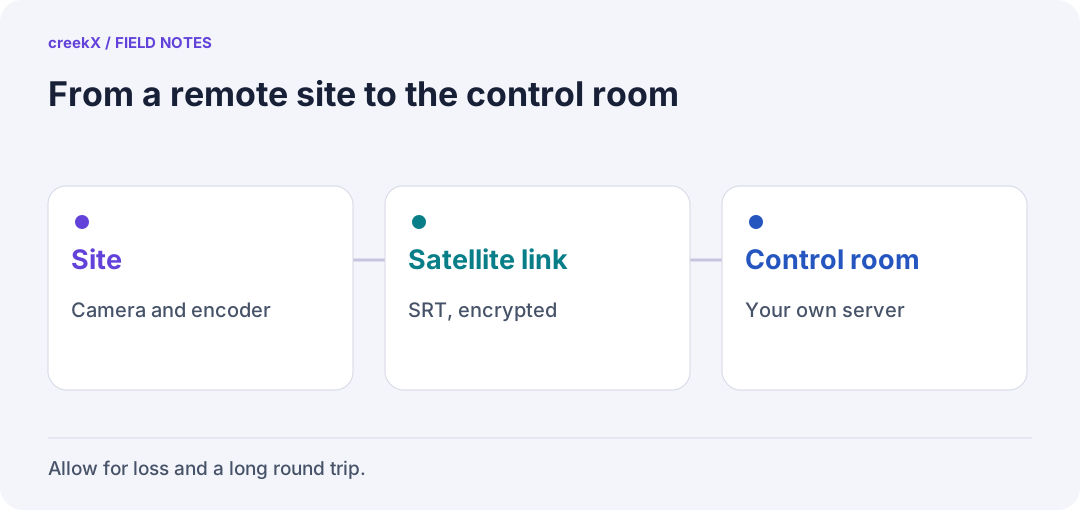
- SiteCamera and encoder
- Satellite linkSRT, encrypted
- Control roomYour own server
Why SRT, not RTMP
RTMP runs over TCP, which stops and waits whenever a packet is lost. On a lossy link the stream falls further behind until it stalls. SRT re-sends lost packets itself, within a delay you set, and drops anything that cannot arrive in time. The picture keeps moving. More on the trade-off in SRT over bad networks.
How much delay to allow
A geostationary satellite adds around 600 ms of round trip by physics alone. SRT needs time for a lost packet to be asked for and sent again, so its latency setting should be several times the round trip, not less. Expect the picture to arrive a few seconds behind. That is normal for satellite, and fine for watching an operation.
Keeping it private
Set an SRT passphrase so the video is encrypted on the way. Where a site sends RTMP or RTSP, use their encrypted forms, RTMPS and RTSPS, which we tested working alongside the plain ones. If security rules say video must not touch the internet at all, run the server on site or in your own data centre with no internet connection: see live streaming on an air-gapped network.
What we haven't tested
We have not yet run creekX over a real satellite link, so we don't quote delay or loss figures for one. Before relying on it, run a test stream over your actual link for a full shift. For several sites at once, see watching many sites from one control room, and the air-gapped streaming guide.
Frequently asked questions
What protocol is best for streaming over satellite?
SRT. It re-sends lost packets within a latency you choose and copes with the long round trip of a satellite link, where RTMP over TCP tends to stall.
Can the video stay on our own network?
Yes. A streaming server on site, or in your own data centre, can run with no internet at all, so video never leaves networks you control.